Miniatures
and More
The Spencer
Doll And Toy Museum holds an impressive collection of dolls and toys from the
past and the present. In addition to dolls and toys, a prominent exhibit of
miniatures is always front and center. A special exhibit case has been dedicated
to showcasing the exciting world of miniatures.
Every few
months a new and exciting display graces the museum. Currently fine quality
miniatures created by Rachel Bonney are highlighted in the miniatures cabinet.
A delightful grouping of tea cups, each with a different miniature scene, are
featured in the display along with a variety of other serious and whimsical
mini-creations. Children and adults alike are fascinated at the level of detail
featured in Bonney’s creations.
We hope to
grow the miniatures exhibits in the Museum. It’s our hope that one day the SDTM
will showcases dozens of fine art displays, featuring the work of hundreds of
miniatures artisans.
The Spencer
Doll and Toy Museum is
located at 108 Fourth
Street in Spencer, NC and open Wednesday
through Saturday from 10am to 4pm. Admission for NAME and UFDC members is $4.00.
Visitor’s should expect to be amazed at what is hidden within the walls of the
museum!
If you are
interested in exhibiting your minis please contact the museum at 704-762-9359.
For more information www.spencerdollandtoymuseum.com
Vintage, antique, and modern dolls and toys, gifts, and party room. Opening July 2012. "A Trip Down Memory Lane"
Showing posts with label doll house furniture. Show all posts
Tuesday, February 4, 2014
Monday, September 24, 2012
October is Doll House and Miniature Month. Let's celebrate!
If you like miniatures you'll certainly want to come by and see the miniature display set up by The Mini Reflections Miniature Club of Mooresville, NC. This past Saturday two members set up a wonderful and varied display of miniatures.
The Mini Reflections Miniature Club is an organization of people in the area of Mooresville, Statesville, Salisbury, Troutman, and Lincolnton who are interested in building and collecting miniatures and learning about miniatures. Mini Reflections is one of the newer clubs chartered by the National Association of Miniature Enthusiasts (NAME) as Club 789.
A miniature is a small-scale reproduction, or a small variation. Unfortunately miniatures aren't governed by any size rule, unless it is a scale size rule. As a hobby, miniatures can be almost anything you want, from reality to fantasy, past, present, future, historically accurate, expensive or hand-made. Creating miniatures is a hobby that everyone can participate in.
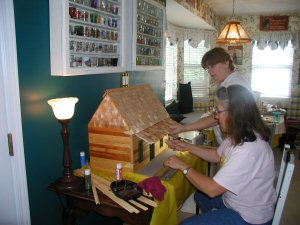
Lynn and Debbie working on the Log Cabin they raffled
off to raise funds for The Victory Junction Gang.
Who has the most famous Doll House in the world?
In the early 1920s, an extraordinary doll's house was created for Queen Mary, the wife of King George V. Queen Mary's Dolls' House is one of the most famous.
The idea for building it originally came from the Queen's cousin, Princess Marie Louise, who discussed her idea with one of the top architects of the time, Sir Edwin Lutyens at the Royal Academy Summer Exhibition of 1921. Sir Edwin agreed to construct the dolls' house and began preparations.
Princess Marie Louise had many connections in the arts and arranged for the top artists and craftsmen of the time to contribute their special abilities to the house. As a result, the dolls' house has an amazing collection of miniature items that actually work. It even has running water through its tiny pipes. It was created as a gift to Queen Mary from the people, and to serve as a historical document on how a royal family might have lived during that period in England.
The dolls' house was put on display to raise funds for the Queen's charities. It was originally exhibited at the British Empire Exhibition, 1924–1925, and is now on display in Windsor Castle, at Windsor, Berkshire, England, as a tourist attraction, especially to people with an interest in miniature houses and furniture.
It was made to a scale of 1:12 (one inch to one foot), is over three feet tall, and contains models of products of well-known companies of the time.
The idea for building it originally came from the Queen's cousin, Princess Marie Louise, who discussed her idea with one of the top architects of the time, Sir Edwin Lutyens at the Royal Academy Summer Exhibition of 1921. Sir Edwin agreed to construct the dolls' house and began preparations.
Princess Marie Louise had many connections in the arts and arranged for the top artists and craftsmen of the time to contribute their special abilities to the house. As a result, the dolls' house has an amazing collection of miniature items that actually work. It even has running water through its tiny pipes. It was created as a gift to Queen Mary from the people, and to serve as a historical document on how a royal family might have lived during that period in England.
The dolls' house was put on display to raise funds for the Queen's charities. It was originally exhibited at the British Empire Exhibition, 1924–1925, and is now on display in Windsor Castle, at Windsor, Berkshire, England, as a tourist attraction, especially to people with an interest in miniature houses and furniture.
It was made to a scale of 1:12 (one inch to one foot), is over three feet tall, and contains models of products of well-known companies of the time.
The displays from the Mini Reflections Miniatures Club will be on exhibit through the end of October. Please come by and see them. You'll be amazed at the detail. You'll also sure to enjoy the lovely doll house donated to the museum from the Krapf family.
(Information and pictures above on Queen Mary's Doll House copied from Wikipedia. For more information visit http://en.wikipedia.org/wiki/Queen_Mary's_Dolls'_House.)
Wednesday, August 29, 2012
During the 1930s North American factories churned out dollhouse furnishings
During the 1930s, due to the Great Depression, times were tough for many people in
But during the 1930s, metal, wood, cardboard and cloth formed the bulk of miniatures, while plywood, fiber-board and cardboard were the choices for dollhouses. Colorful printed papers were glued over these cheap materials.
One of the most popular manufacturers of dollhouse furnishings was a company in Chicago named Dowst. TootsieToy was their trade name. "Tootsie" was the name of a family member who died tragically young at age 16 years. two years later the name changed to "Tootsietoy."
The doll house furnishings were made in a "special composition metal that will not break easily" and, further, that this "almost indestructible metal" would "not break like wood."
This company specialized in small, little playthings like toy cars, planes, and little trains. Dowst also created a line for girls focusing on dollhouse furnishings.
And what's interesting about Dowst
and TootsieToy was they were able to find an economic way to mass-produce
furniture. The original price for an entire set was
$1.25. The smaller sets were a little less expensive and they were
made out of cast metal. The metal is known as "die-cast" and is very easy to cast, providing a lot of detail. The upholstered furniture, featured a
flocked surface so it looks soft, but it's really still a die-cast piece of
furniture.
The kitchen furniture pieces featured in their line are just as detailed. A few pieces in the line included a Monitor Top refrigerator, the type of stove used in the day, a Hoosier-type-looking cupboard.
If a collector were to have a boxed set in the highest condition, he could conservatively value the set, at approximately $200 to $300. But when you really put a whole collection together, the price could increase significantly. At an auction, a full set of eight rooms could be valued between $2,500
to $3,000. .
Today's collectors are still in search of the perfect piece. However on the market today, most of the pieces are maimed pianos, table, sinks, etc., not to mention the chipped paint finishes. The scale of the Tootsie furniture is quite small and ranges in scale from ½ inch to 1 inch.
Subscribe to:
Posts (Atom)