Wednesday, May 2, 2012

Moving in! New Dolls!

We have moved in our dolls, trucks, and trains and are ready to set up exhibits! One of our special summer exhibits will be June Brides. If you have vintage to antique bride dolls or bridal memorabilia such as magazines and photographs, please contact us by leaving a comment. Items may be loaned for the duration of the exhibit or donated.


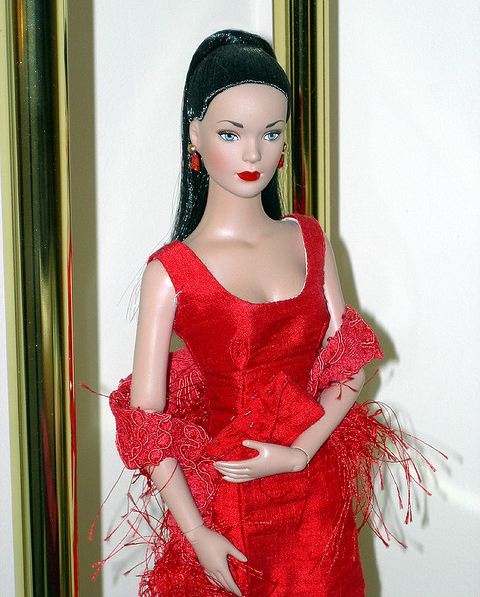
We have also acquired two beautiful new Tonners for our collection. The brunette is Ava Gardner, and the blonde is Rosemary Clooney.


Friday, April 27, 2012

Sweet Nell

The other night, my mother rediscovered a vintage bisque head that belonged to her mother. The wig and body are long gone and the head was broken at some point and amateurishly repaired, as you can see.


This bisque head has smoothly working sleep eyes, missing the eyelashes, and four perfect teeth. The large marking at the top of the head stands for Alt, Beck and Gottschalk, the German company that made the head. This head was, I have been told by experts, made in Nauendorf around 1920. It was probably distributed to a company in New York that was owned by George Borgfeldt. There, it would have been fashioned into a complete doll, with a body, wig, clothing, and earrings for its pierced ears.

The number 1362 is the number of the mold that was used to fashion this bisque head and it is this number that tells us that this doll is a Sweet Nell. She may have looked very much like this when she was purchased for my grandmother:


My Sweet Nell can be repaired. I could have an "invisible restoration" done for around $500...just for the head. The body, wig, and clothing would be more. I have decided to take Sweet Nell on as my own project. I'm not going to attempt to take the head apart and properly reglue it because I don't want to damage the eyes. A mohair wig with bangs will cover the major damage. My plan is to repaint the head, minimize the appearance of the facial cracks, add eyelashes, purchase a suitable body, and commission clothing from a fellow Doll Society member.

I cannot, of course, relegate Sweet Nell back to a trunk. She's spent enough time in the dark. Until she is restored, she'll be displayed in vintage silk, watching the world for the first time in over fifty years.


~Robin

Friday, March 9, 2012

How Not To Care For Your Vintage and Antique Dolls, Textiles, and Old and Antique Photographs

The other day I was scanning scrapbooks for a PowerPoint presentation. Not only were many of the photographs taped to the scrapbook pages, so were newspaper clippings and various notes about people and events in the scrapbooks. Because of that, I was unable to scan a lot of important items since I couldn't remove them from the scrapbook pages without destroying them and I couldn't fit the full pages into the scanner.

You see this a lot in scrapbooks, particularly older ones, and in old photograph albums. Tape and glue are the very worst things for photographs and newspaper and magazine clippings. The adhesive on household tape eventually eats through newsprint, and can tear the backs of photos if they need to be removed from album pages. Our grandparents and great-grandparents were notorious for gluing what are now fragile old pictures to scrapbook pages, often making it impossible to see if there were names and dates written on the back. Of course, our ancestors were also notorious for very often not bothering to write anything at all on the backs of their photos, provoking great frustration in modern day genealogists.

Decorative cardboard corners are widely available for scrapbooking. Gluing in just the corners allows you, or whoever inherits your scrapbooks, to easily remove photos and clippings for scanning and copying. If you really want to make an heirloom for future generations, please invest just a little more time and money and make sure that securing the items in your scrapbooks and albums doesn't end up damaging them. Keeping your old and new albums and scrapbooks in plastic bins with tight-fitting lids will protect them from insects, water damage, and environmental hazards such as cigarette smoke and dry air caused by your home's heating system.

Sunlight is death to fabrics. I have an old, possibly antique china head doll who is dressed in a charming, green plaid handmade dress, the front of which is faded from apparent years of direct sun exposure. Keep your dolls, quilts, bedspreads, and other items with vintage textiles out of sunlight. Antique and vintage quilts are best displayed on quilt racks or hangers. Check frequently for any signs of insect damage. DO NOT store dolls, albums, scrapbooks, or textiles in attics or basements. Although they are the most common storage spaces, they are the places in your home where insect pests such as silverfish are most likely to be found. Silverfish eat paper, photographs, cardboard, and carpet. If you need to store your collectibles in your home, keep them in plastic bins in a closet, under the bed, or in a cedar chest.

When it comes to heirloom objects you treasure and want to pass on to your children and grandchildren, an ounce of your prevention now is worth a pound of frustrating and expensive repair attempts in the future.

~Robin

Thursday, March 1, 2012

Signature Statement Tyler Wentworth

We received our Signature Statement Tyler Wentworth from the Tonner Doll Company. This generous donation will be proudly displayed in our Modern and Collectible Dolls exhibit. As this is our first donated doll, we are very excited to show her off!


Sunday, February 12, 2012

Vogue Dolls

The Vogue Doll Company started in the house of Jennie H. Graves, the company's founder. Ginny is the most well-known of the Vogue dolls. Ginny was designed to resemble a young girl of about five. The first Vogue dolls were composition (glue mixed with sawdust) and had painted-on eyes. In 1948, Mrs. Graves created Ginny and Vogue Dolls began making plastic dolls with sleep eyes, or eyes that open and close. Mrs. Graves also designed the clothing and accessories for the Vogue dolls.


The Vogue Doll Company and the Ginny line changed hands a few times over the years and Ginny lost her classic look for a while when designers attempted to make her more like a fashion doll than a toddler doll. The Ginny line was sold to Vogue again in 1995 and Ginny returned to her old self. Vogue also made Jill, a pre-Barbie fashion doll. We can't wait to feature a Ginny doll in our Modern Dolls exhibit!

~Robin

Thursday, February 9, 2012

Tonner Dolls

Robert Tonner worked for Bill Blass for 18 years before starting the Tonner Doll Company in 1991, with an eye towards making a fashion doll that would rival Barbie. His first fashion dolls were jointed porcelain dolls. The Tonner Doll Company also made porcelain child dolls and then vinyl child dolls while Robert Tonner worked on his idea for a fashion doll. His first fashion dolls were the vinyl American Models, followed by Zoe, and then Julia. Tonner felt that there were problems with the lengths of various limbs in the American Model Dolls, Zoe, and Julia. He finally achieved his vision of his ideal fashion doll with Tyler Wentworth, whose backstory is that of a fashion designer.


Tyler Wentworth

In addition to fashion dolls, the Tonner Doll Company makes vinyl recreations of Betsy McCall, the famous paper doll from the 1950s. The Tonner Doll Company has also designed dolls based on characters from movies such as Titanic, the Harry Potter movies, and Pirates of the Caribbean, as well as dolls based on characters from DC Comics. Tonner has also created doll versions of Bette Davis, Ava Gardner, and Joan Crawford.

We are very excited to be able to feature a Tonner doll in the Spencer Doll and Toy Museum and will post pictures here and on Facebook when we receive it.

~Robin

Wednesday, February 8, 2012

Paper Dolls


Paper dolls have been around in some form or fashion as far back as 800 A.D. The first manufactured paper doll was made in 1810. Paper dolls became popular in the 18th century, where they were amusing toys for the members of the French royal court. English manufacturers used paper dolls to tell morality tales by including printed stories with the dolls. Mothers made paper dolls for their children by cutting pictures out of fashion magazines, such as Godey's Ladies Book, and gluing them to heavyweight paper. Laura Ingalls Wilder had paper dolls made by her mother, and, later, herself and her sisters. When I was a child, my mother made paper dolls for me by cutting out the pictures of the babies on the cardboard boxes of laundry detergent.

I had many paper dolls and enjoyed playing with them more than my Barbie dolls. I loved making up stories for them in my head. Some of the dolls, such as the Ginghams (pictured above) came in boxes that, when set up, contained little dioramas of an old-fashioned bedroom, kitchen, country stores, Christmas parlor, or beach scene. While the Ginghams were by far my favorites, I also had Star Princess, who came with a large diorama, Barbie and various other fashion paper dolls, Alice in Wonderland (whom I never really liked, for some reason) and even Trixie Belden and her friend Honey Wheeler. Of course all my original paper dolls disappeared over the years but from time to time I'm lucky enough to find vintage paper dolls such as the Ginghams and Star Princess on websites such as Etsy. I also have a few modern paper dolls, including Queen Amidala from the first Star Wars prequel. Like the Ginghams, Star Princess, and many of those original paper dolls that found their way into the hands of French nobility, Princess Amidala came with a variety of dioramas. Many of the original French paper dolls were intended to be used to act out plays, and came with little stages.  Paper dolls have been stimulating the imaginations of generations of little girls for hundreds of years. We plan to feature a paper doll exhibit in the Spencer Doll and Toy Museum and to have classes on the history of paper dolls and how to make them.

~Robin